It's been another week passed here in Cuenca taking a break from our constant travels. We managed to do some stuff this week which was a slight change of pace. We finished our Christmas shopping, both for each other and for our families. The packages we sent home should arrive sometime before next year's Christmas. We also stopped in at the local bowling alley and arcade just to have some normal, nothing to do with travel fun.
Before we get to Christmas, we should mention our other highly anticipated activity this week: our feast upon the local Andean delicacy, Guinea Pig. Now, before you judge us for eating your childhood pet, we have been adventurous eaters on this trip, and we had been excited to give this a try. Cuy is a delicacy here and you see them being bought live at the markets and roasted on spickets.
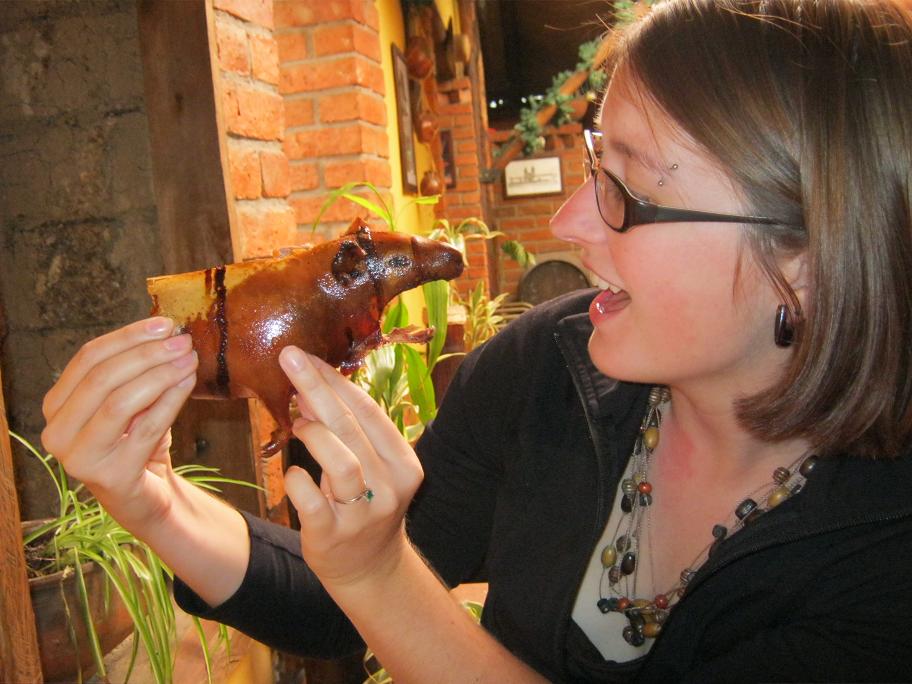
Some things are easy to figure out, but we will never understand why Guinea Pig is considered remotely edible. Of all the crazy things we've eaten, this was the one that pushed the mercury straight out of the grossness meter! After getting over the site of the still intact eyes, teeth, and claws, you battle through a salty crunchy skin to the layer of thick fat before finding a thin layer of very dark meat. The taste wasn't the worst thing, but the grease and fat doomed us to stay in bed for the rest of the day. Never again!
After purging our bodies of rodent meat, we focused on having a great Christmas. The big tradition here in Cuenca is the procession that takes place for a big chunk of the day on Christmas Eve. It was an interesting parade that was focused primarily on children, who dressed in all sorts of fun costumes and walked the streets with their families. Some rode horses or donkeys or sat inside makeshift cars decorated with hanging fruit and other items. Floats carried singers and dancers and people dressed as angels or biblical characters. There's always a lot of dancing and music here in Latin America when there's a festival on.
Our Christmas Day was definitely different than normal, but we really enjoyed it. First off, it was like 80 degrees out and as much as we don't miss the cold weather, it just didn't feel too Christmasy! We also missed our families a lot. But we made a huge breakfast, pancakes with honey and bananas, bacon and scrambled eggs. We opened some small gifts that we bought for each other, Rich got a Budweiser and Kendra a pen! So exciting! We spent the rest of the day drinking mimosas, gorging on chocolate, and just relaxing.
All in all it turned out to be a great day and not a bad way to spend the holidays in our own apartment before we hit the road again this week to head south... FAR south.
This week we continued our main task of doing nothing much of anything, and we feel that we have successfully achieved all that we desired. While it is true that Rich continued to take a few Spanish classes, and Kendra took a few photos, the rest of our daily time was spent in a few new books, a few new recipes, and one or two new TV crime show episodes.
Toward the beginning of the week we ventured out with a few older expats to the edge of Cajas National Park for a trout lunch served with traditional Cuencan sides of habas with aji sauce (large gray lima beans with mild chili sauce) and mote pillo (large corn kernels cooked with eggs and various seasonings). The area was absolutely beautiful and we definitely have intentions to return to hike before we leave.
We also took a mandatory Christmas-time trip to the local mall, where we observed the following oddities: seven straight aisles of nothing but top-to-bottom toy cars, restaurant-grade deep fryers for sale at the JC Penney's equivalent, and live children enclosed in giant inflatable clear plastic balls – all of which are in our pictures for your viewing pleasure. Some things when you travel are just too weird...
Just as many of you have been braving the cold and snow to prepare for Christmas, we have been braving the horribly intense 75 degree sunny weather. Kendra sadly forsook her plans to make a paper Christmas tree when faced with a green construction paper shortage at the local libreria and we opted for an 18-inch mini fake tree and put our crafty skills toward popcorn strings and paper ornaments. We have already received some cards and packages which are now practically overtaking the tree, just as Christmas should be. Although, for some sick reason, we are still waiting for the snow... doesn't seem like December without it.
We don't have a whole lot to update these days because we've been passing most of our time doing a whole lot of nothing, it's outstanding!
It's been very relaxing to be able to put our bags away and shower without sandals on. Cuenca is a beautiful city and the people are friendly which makes our current situation all the more amiable. Besides sleeping late and dragging our asses out of the apartment occasionally to acquire food, we are in fact involved in some things beyond just sustinence.
Rich has been taking more spanish classes and gets frequent compliments from the locals about how well he speaks spanish. He also loves the free coffee the school supplies at all times. Kendra finished her weaving course, learning how to weave on a different type of loom that she used in Guatemala. She made a beautiful wall hanging out of thick wool and managed to speak enough spanglish with her instructor to understand that she was an above average student.
We also have been cooking ourselves senseless, which is great because cooking in hostels is very difficult. We have a big kitchen -- with an oven, a big rarity here -- and the traditional markets in town offer amazing fruits and veggies and fresh chicken and meat. Some highlights have been pasta and meatballs, homemade granola and applesauce, and cinnamon rolls. We're going to be taking a cooking class next week so hopefully we can continue to wow ourselves, a challenging task given how ridiculously awesome we are.
Other than that, we've spent some time with a great group of friends we've met and have just dug hanging out and taking a little vacation from our vacation. What could be better?
Oh, and Chicago, it's about 75 degrees here. Everyday.
Over the past seven days we have settled into our new short-term apartment in Cuenca and made our temporary home for the holiday season. Cuenca is the third largest city in Ecuador with 267,000 people in the city proper and another 200,000 in the metro area. Located in the southern end of the country, in the Andean foothills, the city was built around four rivers that all flow toward the Amazon jungle, which adds to the charm of the city when you cross the frequent pedestrian bridges that pass over a handful local residents washing laundry in the gentle rolling water.
We were lucky enough to find a fully furnished, all included, apartment right outside of the historic downtown center. Most importantly, we were lucky enough to secure a place with a working oven! While we are here through the end of December, we wanted to provide weekly updates, instead of just posting on particular experiences.
We moved into our apartment last Friday, missing Thanksgiving by one day. We decided to hold off on celebrating Thanksgiving until we had full access to our kitchen. So Saturday, we spent 3 hours shopping for our food at the local market and the supermarket (two separate trips) and 7 hours baking the biggest feast of our trip yet. To our dismay the only turkey you can find in Cuenca is 20lbs and frozen solid, a little much for the two of us and our friend Andy. So we opted to by a 5lb fresh chicken instead. Another noteworthy substitution was the mango bread pudding for pumpkin pie. Rich and Kendra battled it out over peas vs. corn and the fresh peas won. The star of the show was the homemade stuffing, which was absolutely amazing (how could it not be with the slab of butter that was holding it together)! We thankfully did not have to move after such an overwhelming meal as on Sunday the entire country was ordered to remain at home for the national census, when local students visit every household in one day. A little different from home for sure.
We took the extra time we had on Sunday to research and book our next destination on our permacation adventure: Patagonia! More on that to come in January.
However, in the meantime before we can play with the penguins, Rich has signed up for another round of Spanish classes and Kendra has already begun more weaving classes (check out the pictures of her half finished wall hanging).
We look forward to sharing our more “normal” life with everyone in the weekly posts to come...but just to give you a hint, it is like waking up to a sunny Saturday morning every day. Tough life.
The small town in southern Ecuador of Vilcabamba is known in as “The Sacred Valley,” and also “The Valley of Longevity.” Residents of the area are rumored to live to the age of 140; now, whether you believe this or not is up to you... mostly it's a place where hippies come to soak up the positive vibes, eat organic foods, and sell their crappy jewelry. For everyone, it's a great place to relax and enjoy the incredibly tranquil atmosphere and beautiful scenery.
We found our niche at an outstanding hotel a mile outside of town called Izchcayluma (eesh-kah-loo-mah). It's a great collection of cabins that includes a restaurant, bar, pool, and a spa. We ate at the restaurant, swung in hammocks, and soaked up the perfect sunny weather while we watched the Chicago-area temperatures plummet from a distance! We enjoyed several outstanding hikes in the gorgeous surrounding mountains, including several that had us walking along ridges where the trail was no wider than two feet during some sections and the cliffs shot straight down on either side. Great walks during perfect weather with surreal views of the great valley.
Not only was our time in Vilcabamba a great way to spend a week before we move into an apartment for a month in the city of Cuenca, but it was a time for celebration for us. We celebrated our 5th anniversary this past week by renting a private cabin. Considering our often less-than-perfect accommodations on this trip, we relished with a private bathroom, private hammock-deck, and views of the mountains – not bad for $18 per night (per person, but that's still ludicrously cheap and it included a massive breakfast!). We celebrated in style with a bottle of champagne and a lush dinner. In our most debaucherous act of celebration, we got 75 minute full-body massage for a meager $18. Pure luxury!
Today, we moved into our own apartment starting for a month and plan to take more spanish and art classes, and cook a big, belated Thanksgiving feast! And with that we left the beautiful Sacred Valley behind.
After the Quilotoa Loop, we both had our eyes on a climb. Kendra is a fierce rockclimber, and set forth to Banos where she tackled a big outdoor wall, even in the presence of a cocky guide who apparently believes fruit only grows in Ecuador... From the time that we left for our trip, we both had a big appetite for conquering a high mountain. We both tackled Tajumulco in Guatemala which was amazing. But here in Ecuador, the Andes commence and there are numerous big-bad snow-capped peaks to wet the appetite, and while Kendra decided to forgo climbing around on glaciers with spiky shoes on until Patagonia, opting instead for the rock walls, spas, and hammocks of Banos, Rich was high enough from lack of oxygen in Quilotoa to give Volcan Cotopaxi a go...
Volcan Cotopaxi is a dormant volcano whose peak is at a whopping 19,347 feet. It is a staple of the Ecuadorian skyline and on a clear day can be seen all the way from Quito 3 hours away. Climbing to the summit is considered by mountaineering standards to be between easy and moderate. Apparently, mountaineering is really damn hard!
Having never done any serious climbing, I wasn't really sure what to expect. I was told that by climbing standards Cotopaxi was easy, but my tranquility was disturbed when I saw the crampons and icepicks I would need to reach the summit. The altitude is also a serious factor: it's important to acclimatize properly in order to walk up to almost 20,000 feet, especially when the walk is straight up a live glacier! Even after hiking around Quilotoa for 3 days, I wasn't sure if it would be enough since the Quilotoa crater lies at only about 13,000 feet.
After getting geared up at the tour office and meeting our guides and the other members of our group (who were great!), we took a bus ride to Cotopaxi National Park. There, we parked the van at 4500 meters and walked 300 meters more with heavy packs on to the Climber's Refuge at 4800. The refuge is a small, crowded, noisy hell-hole designed to keep you from sleeping and eating well before your big climb, then laugh in your face after you fail your summit attempt... luckily, I would have the one left laughing.
After eating dinner with our group and walking to the base of the glacier to have a lesson in ice-pick-crampon walking, we went to “bed” at the wonderful hour of 7pm. After 30 minutes of sleep and 4.5 hours of staring at the ceiling, we woke up, geared up, had a light breakfast, and at 1am started our climb to the summit.
We climbed with our guides through the pitch black with only our headlamps providing light. Ahead, you could see the white dots of other headlamps above you, but not much else. I concentrated only on watching the guide's feet in front of me, making sure not to take any missteps. There were times where in the black you had no idea how steep the ridge was on either side of you or how far you'd fall if you tripped or slipped.
Much of the climbing was very steep, and besides victoriously arm wrestling Kendra, it was the most physically challenging thing I had ever done. My boots dug into my shins, my legs ached and burned, my lungs burnt from the lack of oxygen... but one step at a time I slowly climbed 3000 feet from the refuge to the summit. At 6:15am after 5 hours and 15 minutes, I got to the summit of Cotopaxi. And it was there, among the beauty of the sunrise and other snow-capped peaks in view that I realized... holy crap! I still have to climb down! Three hours later I was back at the refuge eating a Snickers, with a pounding headache and blisters on my shins. But every step was worth it – the beautiful ice formations of the glacier, the crunching of the snow under my crampons, and the view of Ecuador from the top... the only thing better would have been to have my partner there with me... but she was smarter than me and was lying in a hammock instead!
The city of Latacunga, which is situated about two hours south of Quito, holds one of Ecuador's most famous festival, La Mama Negra (The Black Mother). And in case you miss it the first time in September, as we did, they hold an even more rowdy version of the festival again in November. So we put our party hats on and made sure we returned from hiking the Quilotoa loop in time to join the festivities.
They say that the Mama Negra festival originated as a yearly celebration of when the town was spared from the 1742 Cotopaxi Volcano eruption. Their salvation was attributed to the prayers offered to the Virgin of Mercy. This event intertwined with the arrival of black slaves to create the Black Mother. Over the years other Spanish, Inca, and Mayan traditions shaped the festival into what it is today.
The Mama Negra Festival in September is more of a religious festival, whereas the festival we joined in November was partnered with the city's independence day and is more of a giant street party. We attempted to arrive to the parade route early and once we located it, we found that we were not as early as we had hoped. We managed to cross the barriers and walk down the parade route 6 or 7 blocks until we found some empty chairs to rent for a few dollars. The procession itself is comprised of groups of dancers, bands, and people in costumes. However, our rented chairs proved only useful to stand on to see the procession as anyone in the crowd at street level was dancing along with (and often in) the procession.
One unique aspect of this festival is that those in the procession give out candy to children and, unlike festivals in the US, shots of homemade liquor to anyone who appears to be over the age 16. As the parade progressed, individuals would come up to the spectators with jars, casks, bottles, bowls, modified milk cartons, and soup ladles filled with mystery booze (brown, green, blue, and milky white!). In exchange, those in the crowd would share their beer with those handing out shots. In the end, the whole festival is a great excuse to dress up in fun costumes, dance, and drink to excess, all before 11am.
Even as spectators, the party quickly exhausted us and we chose to make our way out of the festivities to rest for the remainder of the afternoon. Unsure of quite how to get out, we ended up making our way back the 7 blocks against the procession (hardly noticed since half of the crowd was in the street anyway) only to find that we were on the wrong side of the barricade. Oh well, we had to party with the locals instead!
We riled up the drunk onlookers with shouts of “Viva Latacunga!” Rich was caught up in a dance with a cross-dresser (men dressed up as women are an important part of the festival as Mama Negra herself is actually an important man from the community who is nominated each year). And both of us experienced on of the oddest parts of the festival. Throughout the parade, groups of men dressed in white would grab spectators, bring them out into the street, dance around them with sticks, and then one of them would spit water or milk on the spectator. This mini-cleansing ceremony would cost the spectator a $1 donation. When we were actually pulled into one of these circles, we discovered that the whole ritual is topped off with a live (hopefully still alive) guinea pig that is shaken all over your body. All in all a great time!
After about a week at the beach in Canoa, Ecuador, we managed to pull ourselves out of the hammocks and away from body-boarding. We forsook our diet of pizza, ceviche, and banana-coladas, and decided that we should once again do something with our lives besides slowly turning into beach bums. The remedy? Grab our hiking shoes and head up into the mountains.
One of the main things we have been looking forward to in Ecuador is hiking and experiencing rural culture around the Quilotoa loop. The loop is comprised of several small mountain villages connected by trails, the most noted village being that of Quilotoa which is situated at the top of a spectacular volcanic crater lake.
We chose to hike from north to south, slowly rising in elevation and ending our last day at the crater lake. We found that the experience did not disappoint us. We hiked a total of about 15 hours in three days, staying in local hostels each night. Sandwiched in the middle was a recovery-from-food-poisoning (Rich) and relaxation (Kendra) day. The hikes ranged from walking on dirt roads, along a river, through grassy fields, and on rocky ledge paths. Some of the areas we passed through were lush and green, but most were surprisingly dry and hot. The final day was the hardest hike as we descended 500 meters (that's 1640 feet Americanos) down into a canyon and then climbed 1000 meters back up out of the canyon, through a town, and then to the top of the volcano. Afterward we bundled up into every layer we own and camped ourselves next to the hostel's wood burning stove as the elevation changed had dropped the temperature dramatically.
As absolutely beautiful as the vistas were, and they were spectacular, one of the more interesting parts of the route is visiting some of the small mountain villages. While some of the villages seemed very used to tourists, we did travel through a few that are newer to the loop that hikers pass through. As we hiked through and near these villages, people stopped to talk with us, shake our hands, and help point us out in the right direction. We got a few “where are you going” as we can assume that they assumed we were a little lost to be in that area.
It happened that we passed through one of these towns on November 2nd, Dia De Los Muertos. In Ecuador, as in many Latin American countries, Dia De Los Muertos is a time to remember your loved ones who have passed away. In the streets people sell flowers, cards, and bread baked in the shape of a baby or child (how this relates to dead relatives we are a little unsure...). Families then spend the day in the cemetery where priests conduct mass. Food is sold outside the walls of the cemetery and then brought in to enjoy and "share" with their deceased relatives. It was a pleasant experience to stumble upon this celebration in such a small and intimate setting.
Overall the hike resembled and surpassed the Sierra Norte hike we did in Mexico. It was also a great way for Rich to acclimatize for his upcoming mountaineering adventure and it provided a great excuse for Kendra to hit the spa for some pampering.
A pig squeals, confused cows are loaded into pickup trucks, guinea pigs are bought for tonight's dinner, chicks and ducks chirp from crowded crates, a man yells unintelligible Spanish into a loud speaker... these are just some of the sites and sounds of the Otavalo animal market.
Every Saturday the small city of Otavalo, surrounded by indigenous villages and beautiful mountains, holds a massive market. Blocks upon blocks of clothes, foods, crafts - anything that can be sold - fill the town center. Tourists come in for the weekend and, along with the locals, haggle over prices with the myriad vendors. You can buy anything from deodorant to Alpaca blankets - of all the markets we've seen it surely takes the cake for size and diversity.
Or, if you want, you can buy a pig... or a cow... or a duck, or a chicken, a kitten, a goat, a puppy, or a guinea pig (the local specialty for the family dinner!). One of the highlights of 7 months travelling is most definitely witnessing the Otavalo animal market. From 5am until about 8am, a giant field is crammed with local farmers buying and selling their livestock and all sorts of creatures. It's a chaotic scene to say the least, the sounds of the animals chattering as well as locals vocally advertising combined with the smells of the livestock and the row of food vendors is complete sensory overload. Sprinkle in a few gringos with cameras and you can begin to get a picture. Make sure to check out our awesome pictures!
You have to see it to believe it, but since most of you can't, we did what we could to provide the next best thing. Check out the video below and make sure to watch and listen closely!
The labyrinth is seen as a sacred pattern that leads the seeker on a path to its center. A labyrinth is not a maze, there is only one way in and one way out, and there are no dead ends that would make the seeker choose directions.