Bunches of new pictures up, and here's a nice looooong post especially for the Math Nerds in our families.
While on our journey we have met a lot of new people who inevitably realize that we are traveling for an extended period of time, and in turn we have encountered a good mix of reactions. Some people recall the time they went on a year long trip; others will joke about how jealous they are. However, one reaction which we have experienced regularly is “You must be rich!” or the even better cousin reaction of “ Your parents must be rich!” We count ourselves very fortunate to be able to able to travel this way; however, we have never really considered ourselves, or our families, RICH. We thought this would be a good time to lift the veil as to how we are still out here after 10 months and, as our parents can testify, have not visited Western Union once.
Before anything else is said, this trip has forced us to acknowledge how lucky we really are. Seeing the poverty of some of these countries has put our lives into perspective. We are rich, not only with our bank accounts, but the fact that we were able to attend higher education and have had good employment history. That said, you don't need to be Donald Trump or anywhere close to travel long term. The biggest factor in traveling long-term is to recognize that it's not a vacation. We had to adjust our expectations from what most Americans consider vacation to be. We're not here splurging on all-inclusive packages or drinking expensive poolside cocktails (though we have our moments), we're here to live a traveling lifestyle that affords us a great deal of freedom, but one that is not unlimited, and that is very different than a typical week at Disney World.
Pre-trip Planning and Saving
Our financial planning for this trip began years ago when we came up with our first budget. Choosing the destination was the first major step. There are travel sites on the web that give good price estimates for visiting various countries. For example, you might see a range for Guatemala of $20-40 per day. Your actual expenses will depend on whether you stay at the cheapest place in town, cook every meal for yourself, and never do organized activities; or if you stay at a slightly nicer place, go out to eat occasionally, and take a few tours. We quickly realized that we would not been able to afford certain regions or countries this time around. You can get a night's accommodation in Nicaragua for the cost of one beer in England. We had to put many of our travel fantasizes on hold...bye bye Italy. We then took the estimates for parts of Central and South America, factored in our tastes/desires, and multiplied by the number of days that we wanted to travel for, and we had our first budget. However, we soon realized that we needed money to buy gear for the trip, for flights, for travel health insurance, for replacement gear, for gifts, for unforeseen expenditures (and how there has been a lot of those), and to come back and live on for a while. All said and done our budged tripled.
It took us a few years and a lot of hard work to be able to save up enough for us to feel comfortable. To meet our goals we not only had to change our perception of “vacation,” but we also changed our lifestyle at home as well. We chose to do without many of the things our friends and coworkers were doing. We cooked cheaply at home for most meals, brought our lunch to work, we became frequenters of thrift stores, we didn't buy a new car, and most importantly we decided not to buy property and instead rented an inexpensive apartment way below our income level. We did make a commitment to enjoy our time in Chicago and went out with friends or occasionally for dinner and a movie. This may have possibly delayed our departure a few months but it was completely worth it.
Keeping Track of It AllAs soon as we started actively saving for our trip, we decided to keep matriculate details of our expenditures. Once we left, we continued with this habit. This has turned out to be one of the most valuable tools to keep us on track financially. Before we left we had a target Cost-Per-Day average that we hoped to reach by the end of the trip. We also had a range for that target number that we felt comfortable with, including an idea of what we could possibly do if we came back with a bare bones return fund.

While traveling we keep track of every credit card charge or ATM withdrawal and add it into our spreadsheets. We calculate how much we are spending per day for each month as well as our overall trip daily average. Now that we are far into our trip we've been calculating more detailed target averages for different return scenarios. Sounds exciting eh? We told you not everything we do out here is for fun.
When you are planning to spend $X per day over the course of the entire trip, you learn that this is a large average. One day you will be way over and the next way under. Forget about days, some months we are way over and some months we are under. We have also learned that large excursions only add pocket change to our daily average over the long haul, and that small expenditures can really add up! A fact that's become very important to our daily lives on the road.
When to Spend and When to SaveIf you are taking a 2 week vacation, you want to enjoy yourself with as much as possible. Go to a nice resort, eat out, stay at nice hotels. However, when you are traveling long term on a tighter budget, the number one factor that can make or break your budget is the type of lifestyle you lead. We won't lie, it has been hard trying to figure our what works for us. When we started out on this trip we watched every single dollar. We tried to stay in the cheapest places, cook cheap meals, and walk everywhere. We have come to learn enough to be a bit more flexible and have personally found that we don't really want to do things as cheap as possible. We will pay an extra dollar to stay at a slightly better hostel or we will pay a few bucks to take a cab from the bus station if it is a mile walk. At the same time, we still have managed to live very cheaply by making smart sacrifices that fit what our travel goals are. Here are the details of many of the things that we do to keep the costs down, keep us out on the road longer, and make the trip a Permacation instead of a Vacation.
 1. Cooking.
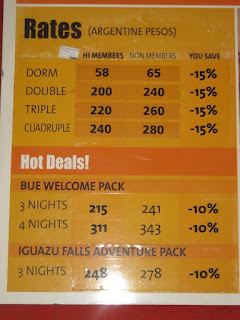
 Depending on the country we are in and what is available, we have consistently only spent between $1-$3 per person per meal on the entire trip by cooking our own meals instead of eating out at restaurants. In some countries we have found this to be more helpful than others. In Guatemala you can get a good dinner for only $4, while in Argentina you will be paying $12. Thus, in some countries we have gone out to eat more than others. We also take advantage of cheap deals when we can, like splitting obscenely cheap, very hearty set lunches offered in many Latin American countries.
2. Housing. Hostels have cost us between $4 and $20 per person per night depending on the quality and location. As mentioned before, we tend not to stay in the cheapest place, but we are still very conscious of the choices we make. In some areas we can share a private room for the same cost of two dorm room beds; however, in other countries, a private room might cost us both double that of a dorm room. Even in those cases; however, we will usually pay the extra $1 per night to stay in a dorm room with 4 beds instead of one with 10 beds.
3. Tours/Activities. One of the largest considerations for doing activities while on a trip of this length is what areas you will be traveling in the future. We purposefully put off white water rafting until we got to Honduras where it is known to be cheaper. We absolutely loved it and want to go again, but we are bypassing the activity in Argentina and waiting again until Peru when it will be a fraction of the cost. We have also chosen to go without some activities that were simply out of our price range (who really NEEDS to go skydiving). Most importantly, we have taken the time to research the cost of the activities we have chosen to do. Sometimes you can get a discount going with your hostel group, other times the price is almost double just to have them drive you there and buy your entrance ticket. Sometimes we get guides, sometimes we go it on our own. Regardless, we try to eventually experience all the activities we have been looking forward to, we just have to wait until the right time, place, and method.
 4. Transport.
 This one is tricky because we have to get from point A to point B and sometimes we don't have much of a choice for the cost unless we want to hitchhike. There have been some countries were transport will make a difference. In Guatemala you can choose to take an expensive shared private shuttle ($10-$20) or take a public chicken bus with several transfers, longer travel times, and possible tight space ($1-$5). In Colombia we found that the long distance bus fares are negotiable. We would get a dollar or two off every ride and it would really add up. In Argentina, the bus costs are a large chunk of our budget. To minimize the effects we take the cheapest bus available, which generally means that our seats do not recline back as far as in the more expensive options and we are served basic meals, but then again we are not sitting next to livestock so we can't complain.
5. Simple Living. This is general but true. We keep shopping to a minimum: if it isn't in chocolate form, we don't have room for it. We constantly fix our clothes and supplies until they are falling apart and we are forced to replace. Most importantly, we tend to have low key evenings at the hostel hanging out with others instead of spending every night out at the clubs.
There are other ways to save a bundle if they fit your taste: camp instead of hostel, work or volunteer along the way, couchsurf, hitchhike or rideshare (safer in these countries than you think), or travel to fewer locations and stay in each for longer periods of time. We've met bunches of travelers who use one or more of these methods to save cash and stay on the road as long as possible... some people have been out for years (don't worry Mom, we're still coming home in May!).
Hope this helps clear things up. No, we did not win the lottery. No, we did not invest in Apple when we were 4 years old. And yes, it is possible for many of you to hit the road if you want to.
 Entering Bolivia from Argentina was a bit of a shock. Bolivia is a bit rougher around the edges: the roads are bad, the people work hard for just a few dollars a day, trash piles up on the side of the highway... not to mention gourmet ice cream shops and steakhouses are completely MIA.
  Sound cool yet? It gets better. The spectacular culmination is the "Salar de Uyuni," aka "The Salt Flats." The Salt Flat is actually a gigantic salt lake, but it doesn't look like a lake. There's a massive deposit of salt at the surface that's 2 feet thick. It's also perfectly flat. This creates 2 different effects: in the dry season, the lake is parched and you can see nothing but blindingly white salt. But now it's rainy season, and the rains have left a 2-inch layer of perfectly flat, still water on the surface of the salt. The result is a mirror effect, the sky reflects perfectly on the surface. Combined with the fact that you can see forever out into the horizon, you lose your orientation. You can't tell up from down, and it looks like you're literally walking on clouds. Stunning.
  Day 2
Day 2 Day 4
Day 4


