Life on the Road Part I: Living in Hostels

Tuesday, January 18, 2011
When you read our blog or look at our pictures, it seems like all we do is sight-see. It looks like we never cease having fun and every moment is perpetual neverending vacation-induced bliss. The truth is that we love our life on the road and we've obviously had and continue to have incredible experiences, but when you travel for so long there's a "real life" aspect that is largely behind the scenes of our blog, our pictures, and our emails to friends and family. After almost 10 months our life has become a routine that's quite different from our life back home, but it's still a routine.

We decided it would be fun and interesting to show you some of the less glamorous, though sometimes equally entertaining aspects of the way we live our life out here as long-term travelers over a couple of posts. We'll start with the issue of meeting our most basic need that we confront each day: where to sleep.

What's a Hostel?

The majority of the time we sleep in hostels. Hostels are not fancy hotels; they are designed with budget-travel in mind. They typically stand apart from hotels in that the vast majority of spaces are shared; many rooms are dormitory style with between 4 and 12 beds (bathrooms are usually communal as well), they have common living areas often with TV rooms, game tables, or bars, and most good ones will have a communal kitchen where guests can prepare their own food. They're a far cry from Caesar's Palace or even the Super 8. We spend most of our nights in hostels, although we have on occasion stayed at slightly nicer "hospedajes" (really cheap hotels) when we have traveled in very inexpensive countries.

The Good

While traveling in hostels is not for everyone, they possess an incredible number of advantages over typical hotels. The first and most obvious is the price. A dorm-bed on our trip has ranged from $4US - $17US per person, per night. Often for only a dollar or two more we splurge for a private room with a shared bathroom. Even a Motel 6 in the USA costs at least $40, and many vacationers easily spend hundreds of dollars a night just on their hotel. Some long-term travelers choose to camp a lot, but for those who like a warm bed with a mattress hostels are a great option.

In addition, common areas like living rooms, TV and game areas offer the opportunity to meet other travelers and make friends, essential when on the road for months at a time. If you are lucky, your hostel may have perks like hammocks, pools, gardens, or even pets. Many hostels have book exchanges where you can trade books you've finished for new ones (Kendra goes through about 4 books an hour, Rich is on his 4th book of the trip). Communal kitchens allow you to cook your own meals which not only saves you an incredible amount of money, but allows you to eat healthy. Traveler's leave leftovers in “free” baskets for others to use and we carry quite a bit of food with us from place to place. We eat the vast majority of our meals at our hostels, not out as we would on a typical vacation, and we have come to realize that a well-equipped kitchen is one of our major pre-requisites when choosing a hostel.

Finally, given that hostels are geared towards independent-minded travelers, they usually offer tons of valuable information. They provide info and directions for activities in their area, can help you book tours and onwards bus tickets and many will direct you to other good hostels in nearby popular cities and towns.

The Bad and The Ugly

While hostels have their pro's there are definitely bad and downright ugly characteristics as well. Cleanliness can be a major issue when you share space with dozens of strangers. We've seen some spotless hostels but also others that should be condemned even if they were situated in the furthest circles of Hell. A good example was our hostel in Tulum, Mexico that didn't have running water, toilet paper, or employees who cared to fix the problem. The hostel made up for these deficiencies, however, with a plethora of broken bikes and cockroaches.

After months on the road it's often tiring to not have your own personal space. Sharing bedrooms and a kitchen gets old after a while and isn't fun when you're frankly just not in the mood for it. Sometimes you just want your own couch, your own bed, and your own pots and pans. We counter this by getting private rooms when we can, mostly so we can throw our stuff everywhere, but in some places (like here in Patagonia), it's simply not affordable for us.

The social scenes at hostels are usually an advantage and we've met lots of good friends, but you also have to share space with people that just flat out annoy you. Some people bug you with their political views or their views about how every other traveler should "eat at 'XXX' restaurant" or "not miss 'YYY' town." The unsolicited advice gets old after a while, as does the same old "where ya from, where ya goin, how long ya been traveling" conversation. You also have the adults who haven't seemed to grow up enough to do their dishes or pick up their dirty laundry.

Other common problems we have in hostels are indifferent to flat out rude staff members, ill-equipped or dirty kitchens, false advertising and incorrect info. Fun times!

Even at the best hostels, we still face a host of small challenges that you would never think about at home. For example, when you are sharing a 10 bed dorm and 3 people are trying to catch a 4am bus, you are probably going to be woken up no matter how quietly they pull their toothbrushes out of their ziplocs. Or how you have to bag and label all your food in the hostel refrigerator; when you are in a busy hostel you have to play “find my white plastic bag” amongst 20 other white plastic bags to be able to eat your food – and sometimes it's simply disappeared.

How We Find and Pick Hostels

So how do you go about finding and picking a hostel? There are tons of websites that are literally hostel search engines, just like Orbitz or Expedia are for hotels. They contain reviews, pictures, and you can make reservations. We also frequent online message boards for independent travelers, but by far the most useful tactic is simply to talk to other travelers at your hostel who have been to where you're going.

We almost never book a hostel in advance. We find that pictures and reviews can be deceiving, so whenever possible we just show up in a city with a few in mind and take a look around. Here's our list of important criteria we always look for when finding a hostel:

- Clean!
- A well-equipped kitchen
- Good sociable atmosphere
- Internet access
- Friendly staff and good information

Our next "Life on the Road" post will focus on how we afford this craziness. Look for it in the next few weeks. Later kids!

El Calafate and El Chalten: Glaciers, Patagonian Deserts, and Jagged Peaks

Wednesday, January 12, 2011
We've been around so many beautiful areas it's hard not to snap a lot of photos, but they'll have to wait because it's a very slow connection here in the middle of the Patagonian internet void! But they're great so feel free to look forward to them...

Our next stop in Patagonia after Ushuaia was a short 18-hour ride away to the town of El Calafate. We had to cross in and out of Chile so the 4 border checkpoints were not fun. Despite all our recent pictures of snow-capped mountains, most of Patagonia is desert and it's barren, flat, and grassy and incredibly sparse of life except for the occasional herds of llamas, sheep, and what appear to be small ostrich (maybe they're emu's??).

El Calafate is a bunch of hotels and shops plopped into the middle of this desert, mainly here for tourists to access the major attraction of the area, the Perito Moreno Glacier. The glacier is absolutely massive and is one of the few glaciers in the world that is not currently receding. We took the bus out one afternoon to see the glacier, taking a boat trip to see it up close and then spending several chilly hours walking along the viewing platforms that have been built on the land opposite the edge. From the platforms you can see the glacier from all sorts of different angles, and the blue hues of the ice formations are amazing. The highlight though are the gigantic pieces of ice that break off a couple times an hour and plunge into the icy lake with crashes that sound like thunder, amazing. The water from the glacial lakes and rivers is also incredibly clear and is drinkable without any filtration or processing, we refill our water bottles right in the river during hikes.

El Calafate also sits alongside Lago Argentina, a giant emerald-green lake. Next to the lake is a bird sanctuary where we spent an afternoon just walking among the flowers, lagoons, and crazy birds flying around (including Flamingo's!). Other than it's proximity to the glacier, there isn't much happening in El Calafate besides an over-priced tourist drag and the sublimely beautiful surroundings of the desolate southern desert.

After a couple of days we headed 4 hours north to the hiking respite of El Chalten. El Chalten didn't even exist until 1985 making it the newest municipality in all of Argentina, but it was built as a hiking, trekking, and rock-climbing Mecca. It sits right in the shadow of several incredible jagged peaks, the most famous of which are Fitz Roy and Cerro Torre, which we were lucky enough to have clear views of our first day here. Tired from the bus, we took a short walk out to a lookout point and soaked in the amazing mountains and warm breeze.

Our hostel is full of professional rockclimbers who bide their time waiting for weather good enough to scale these incredible rock formations, and El Chalten is one of the best places in the world to rock climb. It's also one of the most challenging, so we spent our time taking it easy with a couple of 8-hour hikes! Our first day we walked out to a lagoon at the base of a glacier, through wind battered forest. We arrived at the lagoon and were lucky not to be completely blow off the edge of the Earth, the patagonian winds here are just unbelievable! And that's coming from two people who spent several hours walking through a tropical storm in Guatemala.

The incredible wind never ceases but we wouldn't be deterred, we took another walk yesterday to a freezing cold, windy, rainy lookout point but had amazing views of Fitz Roy and the other peaks as well as a crystal blue glacial lake. The walk was one of the most spectacular we've done as far as the number of vistas we were able to take in, with lookouts over valleys and of mountains and wide river beds. We walked through the woods and over crystal clear rivers... simply beautiful.

Giving our legs a rest for a day or two before tackling some more and continuing to chip away at the distance between here and Lima... long way to go!

Patagonian Penguins

Wednesday, January 5, 2011
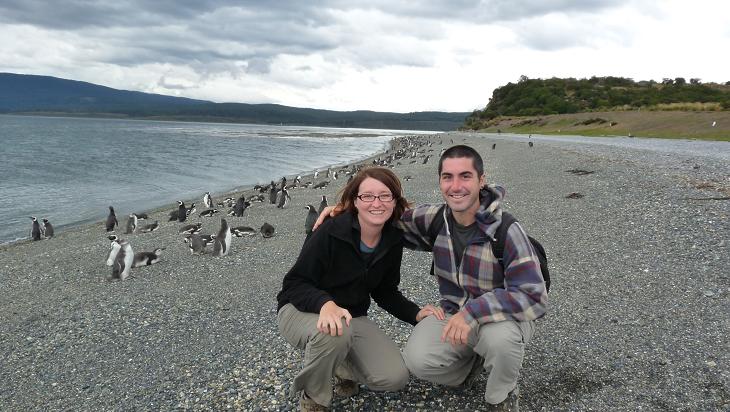
Our time in Ushuaia has unfortunately come to an end as we are heading north tomorrow to El Calafate to see a killer glacier. The last two days here have been wonderful, as we have made the most of this opportunity at the bottom of the continent. Yesterday we splurged and took the penguin island tour, which was one of the most unique experiences of our trip. We started off at 8am with a group of about 20 other tourists. The van drove about 1.5 hours through beautiful country roads. Towering mountains and lush forest scenes the entire way. Once we arrived to the ranch where our boat would be picking us up, we met our marine biologist guide and took a quick tour through their “museum” or what appeared to us to be a marine animal graveyard... with good lighting.

It was only a short 10min boat trip out to the island. Before landing our guide warned us to keep our emotions in control. When we pulled up onto shore and saw hundreds of the most adorable creatures ever (although Rich still maintains they are a little awkward looking), we could understand how it would be easy to get a little out of control and come home with a penguin pet. The island itself is home to roughly 3,000 penguins of two different kinds. We started on the beach and eventually walked around the nesting areas further in. While you were only able to get within 10ft of the penguins on the beach, the penguins in the nesting areas were literally inches from the roped out path. Occasionally one would get interested in our group and wander into the path itself for a closer look. Check out our excessive amount of penguin pictures and keep an eye out for the cute fuzzy chicks which were almost as large as their parents when we arrived.

Today we decided to keep our activities a little low-key and have a picnic on the beach overlooking the Beagle Channel. We took a city bus out towards the edge of town and started walking along the road on the shore line looking for a cove we saw from our earlier boat trip. When we went past the cove on our tour a few days ago, we saw families barbequing on the rocky beach, next to lush grass. Somehow we missed the turnoff for the beach and ending up heading down a path into some woods. Accompanied by two sweet dogs that adopted us for the day, we emerged 20mins later onto an open field of deep green grass and short wild flowers. The views of the channel were spectacular and we had the entire area to ourselves. We picnicked and napped and returned refreshed for our 18hour bus ride tomorrow.

Welcome to Patagonia

Monday, January 3, 2011
First off, we've updated our pictures. The last week in Cuenca, our epic flight, and our first few days in Argentina are all up!

After a very much-needed rest in Cuenca, Ecuador for 5 weeks, we once again hit the road and with a grand change of pace. Patagonia is the southernmost region of both Argentina and Chile, and while we had high hopes for visiting this unique region we were never sure how far south we'd make it after starting in Mexico. Luckily, the travel gods smiled upon us an gave us a cheap flight to the southern edge of civilization, all the way to Ushuaia.

Ushuaia, Argentina is considered by most to be the southernmost city in the world. Further south than South Africa and Australia, we're only 740 miles from Antarctica. Luckily, it's summer here and the weather is a toasty 54 degrees on average. But we've been rewarded with incredible vistas of snowcapped mountains and a myriad of things to do and see. To get here, we took four flights over 48 hours, stopping in Guayaquil, Ecuador; Santiago, Chile; and Buenos Aires, Argentina. We passed our New Year's Eve in Buenos Aires, escaping the airport for a few hours to have a pizza and taste some of the famous Argentinian wine while locals tried to light the streets on fire with homemade fireworks displays: solid layover entertainment.

There's plenty of kickass things to do in Ushuaia. After a day of recovery from our long flight, we decided to jump right in and took one of the popular boat tours of the nearby Beagle Channel, which connects the Atlantic and Pacific Oceans. The Channel is speckled with tiny islands, on some of which live colonies of sea lions, penguins, and various species of birds. The boat takes you up close and personal to the bird colonies and sea lions, whom we saw lying around being fat and lazy right up close! Bundling up to guard your body from the wind, you really start to feel like you're in the Antarctic (or at least close), though it was a gorgeous sunny day and the weather couldn't have been better. We'll be heading out to walk with the penguins tomorrow!

Today was a bit colder and cloudier, but after traveling Central America during the rainy season we're pretty much armed for anything. We took a hike just outside of town to the Martial Glacier along the rim of mountains that line the north side of town. The hike was easy but beautiful and even the clouds contributed to the atmosphere. The glacier wasn't much more than a pile of snow on the mountainside, but it's summer so the levels are low, and you could clearly see the paths the glacier has cut into the mountainside over thousands of years. The streams of water pouring down from the melting glacier in almost every direction were beautiful as well.

We've got a few more days on the edge of the continent before we start moving back north, this is the furthest we'll be from home and from here on out we'll just be heading back in your direction... which should make our Mommies very happy. But there's still plenty of Patagonia adventure left!

A Very Cuencan Christmas

Sunday, December 26, 2010
It's been another week passed here in Cuenca taking a break from our constant travels. We managed to do some stuff this week which was a slight change of pace. We finished our Christmas shopping, both for each other and for our families. The packages we sent home should arrive sometime before next year's Christmas. We also stopped in at the local bowling alley and arcade just to have some normal, nothing to do with travel fun.

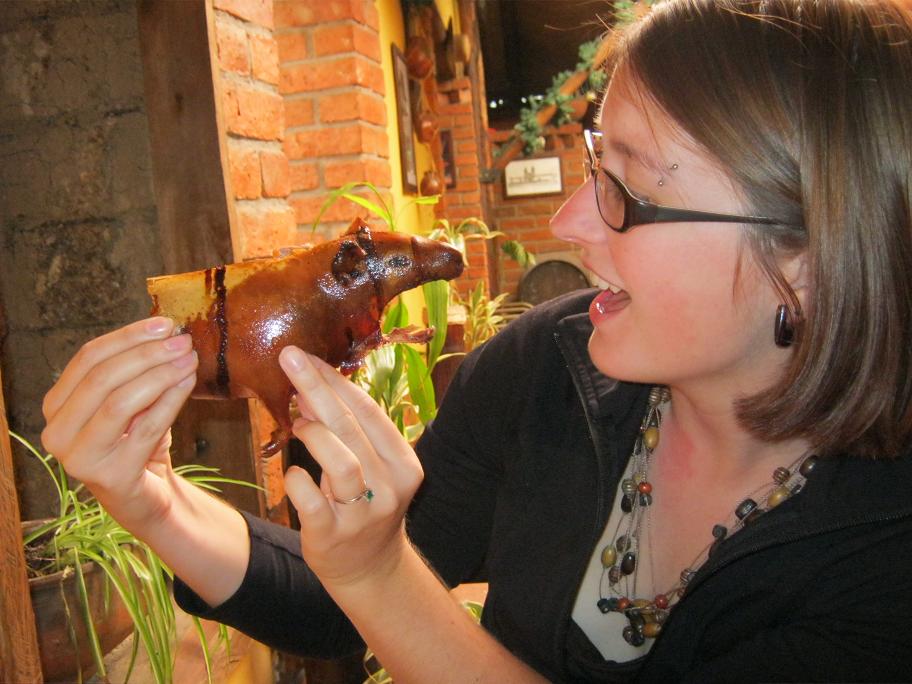
Before we get to Christmas, we should mention our other highly anticipated activity this week: our feast upon the local Andean delicacy, Guinea Pig. Now, before you judge us for eating your childhood pet, we have been adventurous eaters on this trip, and we had been excited to give this a try. Cuy is a delicacy here and you see them being bought live at the markets and roasted on spickets.

Some things are easy to figure out, but we will never understand why Guinea Pig is considered remotely edible. Of all the crazy things we've eaten, this was the one that pushed the mercury straight out of the grossness meter! After getting over the site of the still intact eyes, teeth, and claws, you battle through a salty crunchy skin to the layer of thick fat before finding a thin layer of very dark meat. The taste wasn't the worst thing, but the grease and fat doomed us to stay in bed for the rest of the day. Never again!

After purging our bodies of rodent meat, we focused on having a great Christmas. The big tradition here in Cuenca is the procession that takes place for a big chunk of the day on Christmas Eve. It was an interesting parade that was focused primarily on children, who dressed in all sorts of fun costumes and walked the streets with their families. Some rode horses or donkeys or sat inside makeshift cars decorated with hanging fruit and other items. Floats carried singers and dancers and people dressed as angels or biblical characters. There's always a lot of dancing and music here in Latin America when there's a festival on.

Our Christmas Day was definitely different than normal, but we really enjoyed it. First off, it was like 80 degrees out and as much as we don't miss the cold weather, it just didn't feel too Christmasy! We also missed our families a lot. But we made a huge breakfast, pancakes with honey and bananas, bacon and scrambled eggs. We opened some small gifts that we bought for each other, Rich got a Budweiser and Kendra a pen! So exciting! We spent the rest of the day drinking mimosas, gorging on chocolate, and just relaxing.

All in all it turned out to be a great day and not a bad way to spend the holidays in our own apartment before we hit the road again this week to head south... FAR south.
 

Browse

Followers